
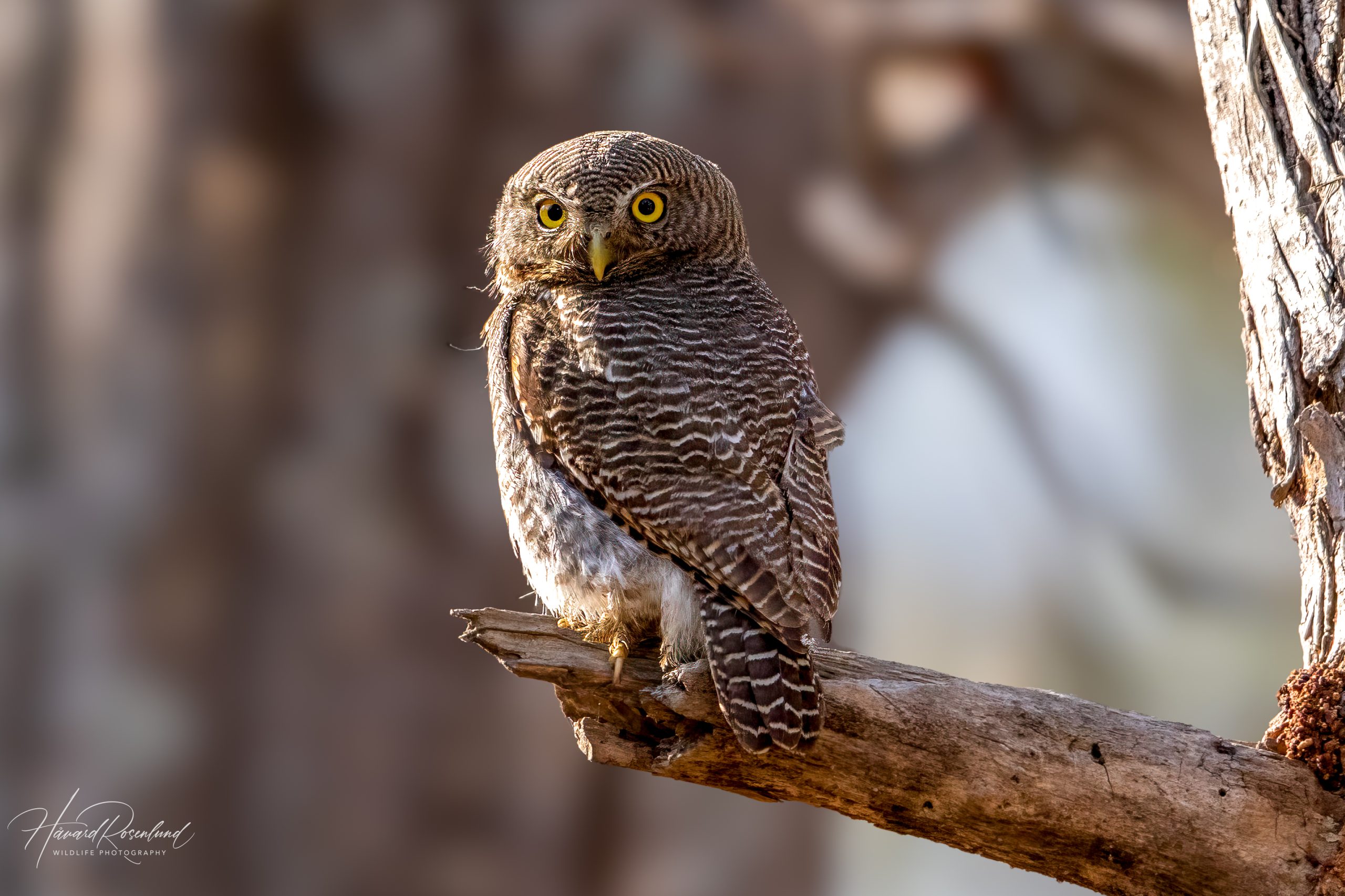
Jungle Owlet
Glaucidium radiatum
At a glance
Habitat
- Dry and moist deciduous forest, secondary woodland, scrub and wooded ravines
Diet
- Mainly insects and other invertebrates; also small vertebrates
Activity
- Most active around dawn and dusk; also active by day
Size
- Length: 19–22 cm Weight: —
Range
- Indian subcontinent and adjacent parts of South Asia
Description
The jungle owlet (Glaucidium radiatum) is a small, compact owl of South Asia, about 19–22 cm long and weighing roughly 90–115 g. It has a rounded head without ear tufts, bright yellow eyes and dense pale barring across the dark brown upperparts and paler underparts. The facial disc is weakly defined, giving the head a relatively plain, rounded appearance.
The similar spotted owlet (Athene brama) is more strongly spotted rather than finely barred and has a clearer pale facial pattern. Jungle owlets also look stockier and more uniformly barred across the body. Despite their small size, they are efficient hunters and are often conspicuous when calling from exposed branches around dawn and dusk.
Habitat
Jungle owlets are primarily forest birds. They use dry and moist deciduous forest, secondary woodland, scrub forest, wooded ravines and riverine vegetation, and can also occur in plantations and other modified landscapes where enough tree cover remains. They are much more closely tied to wooded habitat than the spotted owlet, which lives in many of the same regions but makes greater use of open farmland and settlements.
A study published in 2023 from Gujarat and Maharashtra found jungle owlets more often in areas with greater forest cover and denser canopy cover, and less often where bare ground covered more of the landscape. In the same landscapes, spotted owlets and the much rarer forest owlet (Athene blewitti) used different combinations of woodland, agriculture and open ground. This habitat partitioning helps the three small owl species coexist.
Diet
Invertebrates form the core of the jungle owlet's diet, especially large insects such as beetles, grasshoppers and other arthropods. Small mammals, lizards, frogs and birds are also taken, but jungle owlets are more strongly insectivorous than many other small owls.
A study published in 2018 from the East Kalibhit forests of Madhya Pradesh compared jungle, spotted and forest owlets living in the same landscape. Invertebrates made up 84.8% of recorded prey in jungle owlets, which also had a narrower prey spectrum than the other two species. This dietary separation helps reduce competition among the three owls.
Hunting
Jungle owlets usually hunt from a perch, watching the surrounding foliage and ground before making a short, rapid attack. This perch-hunting strategy suits a small forest owl that takes both large insects in vegetation and small vertebrates closer to the ground.
Behaviour
Jungle owlets are resident and are especially active around dawn and dusk, although they also call and can be active in full daylight and during the night. Their repeated calls often make them easier to locate than their barred plumage among branches.
They are territorial and usually occur alone or in pairs.
Breeding
Breeding takes place mainly during the late dry season and early summer, commonly from about March to May in India. Jungle owlets nest in tree cavities, including natural hollows and old woodpecker holes, rather than constructing an exposed nest. A clutch usually contains 3–4 white eggs laid directly in the cavity with little or no nest lining.
A study published in 2022 from East Kalibhit in Madhya Pradesh found jungle owlets using particularly tall, large nest trees compared with the two other small owl species in the area. Nest trees averaged about 17.8 m in height, with nest cavities around 8.5 m above the ground. Both adults defend the nesting area and provision the young. Large, mature cavity-bearing trees are therefore an important habitat feature alongside the surrounding forest used for hunting.
Status
The jungle owlet is classified as least concern on the IUCN Red List and remains widespread across much of the Indian subcontinent. The global population trend is considered stable.
State of India's Birds 2023 places the species in the low conservation-priority category and treats it as a forest and plantation specialist. The report did not calculate national trend estimates for primarily nocturnal species such as most owls because they are less well represented in large observation datasets. Jungle owlets can use secondary forest and some plantations, but loss and simplification of deciduous woodland can reduce local habitat quality, especially where mature trees with nesting cavities disappear.
Image gallery
Loading map and observations…
Have you seen this species?
Independent species archive
Did you find this species page useful?
Wildlife Vagabond is independently built and maintained. Voluntary support helps cover hosting, maps, data storage and continued improvements to the species archive.
Support Wildlife VagabondSpecies content will remain freely available.
References
- BirdLife International. (n.d.). Jungle Owlet species factsheet. https://datazone.birdlife.org/species/factsheet/jungle-owlet-glaucidium-radiatum
- India Biodiversity Portal. (n.d.). Glaucidium radiatum. https://indiabiodiversity.org/species/show/257735
- International Union for Conservation of Nature. (n.d.). Jungle Owlet. The IUCN Red List of Threatened Species. https://www.iucnredlist.org/species/22689283/93225315
- Khan, Z., Sushma, H., Antony B, P., Koli, K., Neema, A., Meera, M. R., Arasumani, M., Robin, V., Jayapal, R., & Mukherjee, S. (2023). Habitat determinants of species occupancy and niche partitioning among sympatric owlets: the paradoxical role of agricultural lands for the endangered Forest Owlet, Athene blewitti. Journal of Field Ornithology, 94(2), art1. https://doi.org/10.5751/JFO-00244-940201
- Mehta, P., Kulkarni, J., Talmale, S., & Chandarana, R. (2018). Diets of Sympatric Forest Owlets, Spotted Owlets, and Jungle Owlets in East Kalibhit Forests, Madhya Pradesh, India. Journal of Raptor Research, 52(3), 338-348. https://doi.org/10.3356/JRR-17-00002.1
- Natesh, M., Vinay, K. L., Ghosh, S., Jayapal, R., Mukherjee, S., Vijay, N., & Robin, V. V. (2020). Contrasting Trends of Population Size Change for Two Eurasian Owlet Species—Athene brama and Glaucidium radiatum From South Asia Over the Late Quaternary. Frontiers in Ecology and Evolution, 8, 608339. https://doi.org/10.3389/fevo.2020.608339